 Skip to main content


Blog

Data democratization:
tools once reserved for major racing organizations, now within everyone’s reach
Technology does not level the financial playing field, but
it can bring working methods closer together. Making
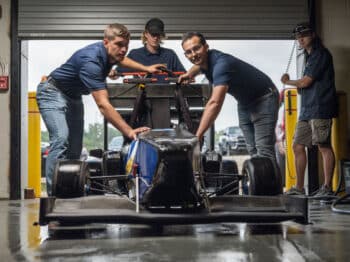
Technology does not level the financial playing field, but it can bring working methods closer together. Making better use of information is no longer exclusive to top-tier teams.
Performance gaps exist across every sport, and motorsport is no exception. However, the way those differences manifest themselves has changed over time. For decades, the gap between the most powerful and the smaller organizations — between major teams competing in leading championships and amateur teams entering the sport — was largely determined by budget, technical capability, staff size, component quality, and the resources available for testing. As technology became increasingly integrated into racing, those differences became even more noticeable. Having a good car and skilled technicians was no longer enough: it also began to matter who could collect more data, process information better, and turn that information into decisions.
For years, specialized tools remained closely associated with the racing organizations that had the greatest resources. Larger teams could develop their own systems, bring in specialists, and build increasingly sophisticated processes, while smaller operations handled much of their work through spreadsheets, notes, folders, and improvised solutions. Over time, however, one thing became clear: a bigger budget does not guarantee a more organized way of working. Even today, some major teams still manage setups, tires, driver feedback, files, or tasks through fragmented methods that are poorly connected with one another.
The difference, then, is no longer determined solely by how much a team can invest, but also by how it organizes and uses the information it generates. And that creates a new opportunity. The development of cloud-based software, SaaS models, and specialized tools has made it possible to access solutions that once required proprietary infrastructure or substantial budgets. Teams of different sizes can now adopt more efficient methodologies, preserve their technical history more effectively, and work with connected information within the same environment.
RaceData is part of this transformation, showing that competing with fewer resources does not mean working in a disorganized way. Likewise, having a larger budget does not automatically mean working better. The advantage increasingly lies with those who can organize, connect, and reuse what they already know more effectively.
The data is already there — the challenge is not generating it, but managing it
Even a small team can generate a considerable amount of information during a race weekend. There are lap and sector times, different car setups, tire information, fuel loads and consumption, driver feedback, onboard videos, photographs, technical documents, and data acquisition files. The problem is that generating information does not necessarily mean using it effectively.
A team may finish a race with hundreds of data points and records spread across different places. The setup in one spreadsheet. Tire pressures in another. Driver comments in a phone note. Videos on a memory card. Data acquisition files on a laptop. Timing data on a timing platform. Pending tasks in a WhatsApp group. Each solution may work individually, but the challenge begins when that information needs to be connected.
For many years, large teams addressed this by developing internal procedures, proprietary tools, and structures in which different people were responsible for specific areas. The engineer had their own records, the tire technician had theirs, the data analyst worked with timing and technical files, while other team members handled documentation, tasks, and logistics.
In a smaller organization, many of those responsibilities may fall to the same people, and that is where an important difference emerges. For that reason, the ability to centralize and organize the work can be even more valuable.
From isolated tools to a system
What has changed in recent years is not only the arrival of new technologies, but above all how accessible they have become. In the past, adopting a specialized solution could mean purchasing expensive licenses, installing software on dedicated computers, maintaining servers, or developing tools internally. Today, the SaaS model makes it possible to access professional platforms through a web browser, pay for a subscription suited to the size of the team, and increase capacity as its needs evolve.
A laptop that once contained dozens of folders — to the point of requiring external drives because its storage was no longer enough — can become an access point to a system where different people work with the same information. An engineer can review a setup, the tire technician can log a set, the driver can leave feedback, and another team member can review lap times or retrieve a file from a previous race.
This does not mean specialized tools disappear. Data acquisition software will continue to serve its purpose. Timing systems will continue to produce their records. Cameras will continue to record footage. But all that information can now exist within a single system that connects it, without requiring the multimillion-dollar investment once reserved for elite teams.
One point is particularly important: introducing technology alone is not enough to turn a team into a professional organization. A dashboard does not replace an engineer. A data acquisition file does not explain a lap by itself. An onboard video does not determine what changes should be made to the car. And storing a hundred previous setups is of little use if nobody knows which one applies to the current conditions. For that transition to happen, technology needs to be supported by a working methodology.
That is where the real opportunity emerges for amateur and semi-professional teams: new tools are now available, but simply having access to them is not enough. Their real value comes from being part of a more structured workflow.
Systematically recording setup changes, the pressure and temperature of every tire set used, or how the driver felt with a particular configuration are common procedures within professional racing organizations. But they do not necessarily depend on having dozens of engineers. Above all, they depend on having a methodology that keeps information organized and makes it accessible to the people who need it.
Knowledge as a valuable resource
A small team is unlikely to multiply its staff overnight. But it can improve the way it uses the time, information, and knowledge of the people already within its organization. This is where an important difference emerges between established teams and those still developing: the ability to transform accumulated experience into technical memory — knowledge that remains available to the entire organization.
Over the course of multiple seasons, a team builds an enormous number of references: what worked at a particular circuit, how the car responded to a specific setup, which tire pressure produced better results, what a driver reported, how much fuel the car consumed, or how a tire evolved over a long run. All that information has value. The problem arises when it exists only in people’s memories, or in places that are difficult to access during the short and intense periods between runs.
During on-track activity, urgent matters have to be resolved first. Every time the car is preparing to leave the garage, a series of decisions has already been made under the pressure of the moment, with the responsibility of improving its performance. In that context, recording and organizing information can easily become secondary. Yet something that seems unimportant today may become a decisive reference months later — or even during those same high-pressure minutes before the car goes back out.
When the team returns to the same circuit, faces similar conditions, or needs to understand why a particular decision was made, having that information available prevents it from starting again from scratch. It allows previous experience to be recovered, different scenarios to be compared, and every hour of work to be used more effectively.
That is why digitizing and structuring information does more than help organize the present. It also allows a team to build its own technical knowledge base, where knowledge accumulates race after race and season after season.
This democratization of technological resources does not mean that every team can compete on equal terms with major organizations from top-level championships. What has narrowed is the gap in the ability to organize, record, and access information, without requiring a multimillion-dollar budget.
A team may still have only a few members while sharing the same technical history. It may compete in a regional championship while keeping its setups organized by event. It may have a single engineer and still preserve structured feedback from different drivers. The resources may not be comparable, but the way information is managed can follow a similar logic when the work is organized around a system.
RaceData is part of this transformation
The platform was developed to centralize the technical, operational, and analytical management of a racing team within a single environment. Timing, setups, tires, fuel, driver feedback, analysis, tasks, calendars, onboard footage, and technical files can all be organized around the same structure of championships, events, sessions, cars, and drivers.
The goal is not to replace the engineer’s knowledge or the specialized tools already used by the team. Nor is RaceData intended to manage telemetry. RaceData allows teams to store and organize the data acquisition files generated during different sessions, integrating them into the corresponding technical history alongside the rest of the team’s information.
A setup is not simply stored as another file. It can become part of the car’s history. Driver feedback can be linked to the configuration that was used. Tire information can be analyzed alongside the corresponding run. An onboard video can be linked to its session. A task can be assigned to a team member. And a previous race can become a reference point when the next one begins.
For a professional organization, that means centralization and traceability. For a smaller team, it can mean something even more important: access to an organized working methodology without having to build the entire infrastructure from scratch.
Technology is not here to replace experience or talent
Nor does it replace technical ability or intuition — qualities that continue to make a difference when developing a race car. But technology can complement all of them by reducing time spent on repetitive processes, preventing valuable records from being lost, preserving knowledge so that it can be used by any member of the team, and providing a framework for the work carried out by everyone within the organization, regardless of its size or the championship in which it competes.
Because competing more effectively does not depend solely on having more resources to generate information. Today, a vast amount of data is already available to teams at different levels. The difference lies in what happens afterwards: how that information is organized, how it is preserved, and how easily it can be retrieved when it becomes relevant again.
For a long time, that capability was primarily associated with organizations that had greater resources. Today, access to specialized software allows smaller teams to adopt these same ways of working. And when differences on track are measured in thousandths of a second, the way a team operates away from it — in a coordinated, efficient, and structured manner — can also become the factor that determines who gains the advantage.