 Skip to main content


Blog

When data
needs a driver: why driver feel matters when analyzing a race car
Timing tells you the result, but it does not
always explain the cause. Driver feel can be
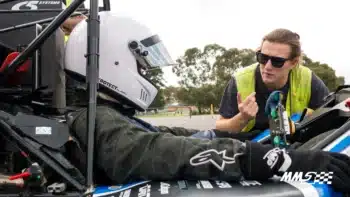
Timing tells you the result, but it does not always explain the cause. Driver feel can be the missing piece in understanding what the car is doing.
In modern motorsport, virtually everything can be measured. Acceleration, braking, engine speed, tire temperature, pedal position, steering angle, and hundreds of other parameters are part of the enormous amount of information a team can collect during a track session. However, there is one piece of information that no sensor can fully capture: what the driver feels.
Data acquisition allows us to understand what the car did. The driver’s perception helps us understand how and why it did it. Neither replaces the other. The driver cannot replace the data, and the data cannot replace the driver. The real opportunity to improve performance comes from analyzing both sources of information are analyzed together.
The most important sensor in the car is sitting behind the wheel
Lap times determine the result. There is no ambiguity there. A lap is faster or slower, a sector improves or gets slower, the pace remains consistent or begins to drop off. The numbers tell us what happened on track, but they leave one important question unanswered: why did it happen? Understanding the causes — from a tire losing grip to a moment of hesitation from the driver on corner entry — requires more than simply looking at the data. Something else is needed.
That source of information is the driver’s ability to feel and interpret what the car is doing. An experienced driver can identify trends that may not immediately show up in the data. Slight understeer during a particular phase of a corner, a different response from a new setup, a loss of rear traction. Even when the lap time is competitive, these observations can help the team keep improving and anticipate problems that could later cost tenths — and those tenths can be worth everything.
That is why driver feel can be considered a kind of human sensor, capable of interpreting phenomena that are difficult to measure directly. These are not simply opinions or casual comments. They provide a foundation for interpreting the data afterwards, comparing both sources and making the necessary adjustments. That is part of the engineer’s job.
How to turn feedback into valuable information
The driver’s perception is inherently subjective, but because the driver is the one making decisions behind the wheel, that subjectivity cannot be ignored. Where does the car feel better? Where does it lose stability? Where does the driver feel oversteer? Turning those sensations into usable information is also part of the team’s job. In fact, when driver feedback is recorded systematically and connected with objective data, it can become an extremely valuable engineering tool. The problem arises when that feedback gets lost — something that happens far more often than we might think.
In the vast majority of racing teams, the process is still informal. The driver gets out of the car and talks to the engineer: “It’s pushing,” “it struggles in the slow corners,” “the tire dropped off.” Afterwards, there may be no record of that conversation beyond the engineer’s memory, a quick note on a setup sheet, or something typed into a phone — a process that can sometimes look more like a shopping list than an engineering record.
Whether it is a test or a race weekend, the relevant changes are made, the new setup is recorded, the appropriate tire set is fitted, and the car goes back on track. By the end of the day, dozens of decisions have been made that can be difficult to reconstruct accurately: why each decision was made, what information supported it, and whether something similar had happened before? When the team returns to the same circuit, will anyone remember what worked best the last time?
That is when the search begins: setup sheets, notes, messages, and memories. The problem is not that the information never existed. The problem is that it existed, but became disconnected from the technical context that gave it value. The data may still be there, but it becomes difficult to reconstruct exactly how everyone interpreted it at the time.
Giving context to driver feel
Imagine a driver finishes a run and says, “the rear started stepping out after four or five laps.” On its own, that statement does not tell us where the problem lies. But its value changes completely if we know which setup was being used, what configuration had been used in the previous run, what changes were made between the two, which tire set was fitted, how many laps it had accumulated, its pressures and temperatures, the fuel load, and how the lap times evolved lap by lap. If we also know in which sectors the loss of performance began to appear and what the driver had reported during the previous run, the feedback stops being an isolated sensation and becomes useful information for analysis.
Now we no longer have just an opinion. We have context. And that context allows us to start building hypotheses: did the balance change after adjusting the anti-roll bar?, did it coincide with an increase in front tire temperatures?, does the problem consistently appear after a certain number of laps?, was the lost time concentrated in corners with similar characteristics?, did another driver on the team report the same sensation?
Feedback then becomes another variable within the analysis process. The data helps validate what the driver feels, while the driver’s feedback helps guide engineers toward where they should look in the data.
Consistency in communication: another key factor
There is one more element to consider, one that may be less obvious but is no less important: the way drivers describe the behavior they feel in the car. The exact same behavior can be described in completely different terms by different drivers, and even the same driver may use different words to describe identical situations.
That is why teams with structured working methods usually develop a common language between the driver and engineering. Once that history exists, patterns begin to emerge. A particular driver may repeatedly report stability problems with a certain configuration. A specific setup and tire combination may trigger the same comment at different circuits. A change that initially improved lap time may also have reduced the driver’s confidence and ultimately affected consistency. These conclusions are difficult to reach when each comment is separated from everything else that needs to be analyzed. This is where RaceData comes in.
All your data — including driver feedback — organized and structured
When every piece of information lives separately, everything becomes harder to analyze. Instead of analyzing what happened during a session and determining how to improve performance, the engineer first has to organize the setup sheets, search through messages for the driver’s feedback, and then bring all of that together with the data acquisition files stored in a separate platform.
When we look at the long term, feedback becomes even more important: a race weekend can generate information that helps solve a problem at another test or event months later, when the team returns to the same circuit or encounters similar weather and track conditions, providing a reliable starting point.
But for that to happen, it has to be recorded. Imagine being able to return to a previous race and quickly reconstruct the car’s configuration, the changes made throughout the day, how the tires evolved, the lap times achieved, which sectors improved, and what the driver reported after every run. That turns every event into part of an accumulated technical memory. Knowledge no longer depends exclusively on the people who were there at the time; it becomes part of the team’s technical memory.
This is exactly one of the problems RaceData solves. In our Driver Feedback (Handling) module, the platform ensures that the driver’s perception does not become an isolated comment, but instead a piece of information linked to the context of the session in which it was generated. Driver feel — measured through different levels of understeer and oversteer at corner entry, mid-corner, and exit — can be connected with the setup being used, the tires, timing, runs, and the rest of the relevant technical information.
This means that when the team analyzes a session, it can see more than just numbers. It can understand which configuration the car was running, what happened on track, and how the driver perceived it. The difference is significant. Because a comment made as the driver gets out of the car stops being just that: it becomes a piece of information associated with a specific configuration, a particular tire set, a specific session, and measurable behavior on track.
That connection allows the team to return to the information after the race and examine it in greater depth. It also makes it possible to retrieve it weeks or months later without relying on someone remembering who said what or finding an old conversation. At RaceData, we know that every piece of data matters. And the driver matters too. But not when each exists on its own. The real value appears when all the pieces are connected.